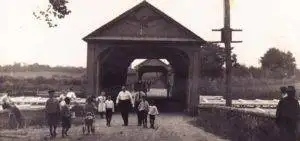
Information below was taken from Karen & Josh Ruza’s Lake Lonnie presentation.
Karl Scott began digging the lake in approximately 1945. He had help from a few of the local Polish – Lithuanian residents in the Cambridge Section of town.
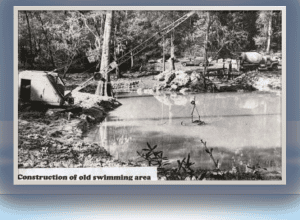
Karl Scott had learned about building a spring fed lake property from his Aunt Virginia, the original owner of Virginia Lake. More recently it has been known as Olympia Lakes and The Willingboro Nature Preserve and is now in the process of transitioning to the Burlington County Parks System. It took approximately 3 years to dig the lake using various forms of equipment. He had put up barbed wire all around the property, during construction to deter unwanted visitors. During this period, Lover’s Lane was located at the end of Fifth Street, so people knew work was going on. In approximately 1953, Karl Scott opened the lake property, calling it “Lake Lonnie”. He had decided to
name it after his wife Yolanda Bontivoglio, whose family-owned Camden Iron and Metal in Camden. Karl called her “Lonnie”. First of course he hired a series of lifeguards, who’d obtained their Red Cross Lifesaving Certifications.
As many as 15,000 guests would arrive over the course of any one season during the time period that Karl Scott ran the lake property from 1953-1968. Some current neighborhood residents will tell how the cars would be lined up for blocks and blocks all the way down to the railroad tracks, waiting to enter Lake Lonnie.
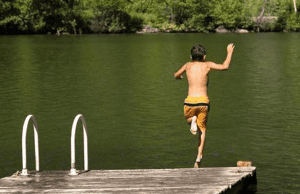
The 10’ X 30’ float held 4 ladders to provide lots of opportunity to dive and splash.

In or around 1967, Karl Scott saw that the number of visitors had begun to decrease, from the 5000 or so people that he had come over the course of one weekend, in its heyday. There was a lot of advertising being marketed for the NJ Shore. Also, air conditioners were becoming more popular. Mr. Scott became interested in building a 400 acre marina in Maryland. The Lake Lonnie property was eventually sold to Karl Scott’s cousin, Jim Jordan in 1968. Mr. Jordan was a builder who had plans to sub-divide the property.
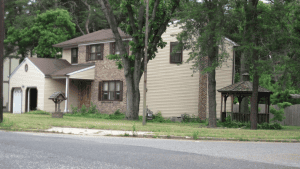
After Mr. Jordan had sub-divided twelve lots, he began building ten homes on Leon Avenue and two homes on Fifth Street. He was unable to be at the lake continuously but was nearby if a problem arose. This is the home now, that was then the Jordan’s home at the corner of the two streets.
In the early 1970s, Delran Township officials approved of plans for The NJ American Water Company to drill a water pumping station on Leon Avenue 500 feet from the spring fed lake. Gradually, only 9 feet of water was available in Lake Lonnie. By the end of August that year, the float was pulled from the water and 2 feet of sand was scraped out of the water below the entire lake. This was a normal part of maintaining the lake and was done every few years. However, no matter what steps were taken to improve the water flow and bring the sand back up on the beach, the water level never increased. It became unsafe to allow anyone to jump from the diving boards, which were removed. This caused the visitor numbers to drop considerably as word got around.
With competition from the other swimming lakes, the many area residents having added swimming pools in their yards and now this, Mr. Jordan began applying for his 2nd round of home building on his property wishing to add 55 more homes. His plan was to build the homes surrounding the lake, with those closest to the lake being most valuable.
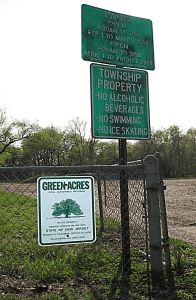
After a four-year court fight with Jim Jordan, the Lake Lonnie property was acquired by Delran Township in 1976, via the Green Acres Land Acquisition and Recreation Opportunities Act, robbing Mr. Jordan of his dream. At the time, Delran Township Mayor Lorraine Schmierer played a large part in obtaining the property through a Green Acres Grant. It was a part of the land being acquired on both sides of the Swedes Run Stream running across from the Willow Brook Country Club on Bridgeboro Road in Moorestown, all the way to the railroad tracks along St. Mihiel Drive.
To read Karen and Josh’s entire presentation, click on the link below,
History of Lake Lonnie by Karen & Josh Ruza